Upright or Spreading Plants for a Narrow Border?
Upright or spreading plants for a narrow border? Compare mature shapes, test a layout with pots and markers, and keep paths and views clear.
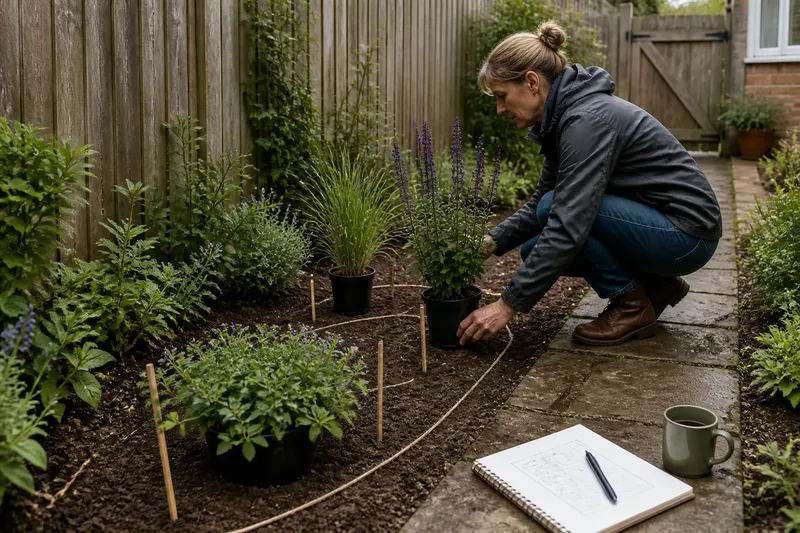
A tray of young plants can make a narrow border look easy to fill until you set it beside the fence and notice how little room the path leaves. Upright or spreading plants for a narrow border work best when you compare their mature shapes with the space you need to keep open.
Read the Border
Stand where you usually enter the garden, then look back from the house or the path. Note where the border pinches narrow, where a gate or hose needs access, and which view you want to preserve. A quick sketch on graph paper is enough; mark the fence, path, and any existing plants.
Watch the light during the parts of the day you use the garden. Check whether the soil tends to stay damp or dry, too. Plant form depends on a plant staying suited to its spot: a candidate that struggles there may not keep the upright or spreading outline you chose.
Use a notebook to record the site conditions and copy the mature height, mature spread, and growth habit from each plant label or supplier description. If a label is unclear, ask a local nursery before assigning the plant a tight space.
Compare Plant Shapes
Upright plants concentrate their shape in a narrower footprint. Look for descriptions such as erect, columnar, or clumping, then check mature spread as well as height. A narrow ornamental grass, an upright salvia, or a compact vertical shrub could suit a spot, but only if its light, soil, and eventual size match the site.
Spreading plants take up more horizontal room. A broad mound or ground-covering perennial can soften the edge and connect gaps, but its mature spread may crowd a path. Check whether it expands by creeping stems, self-seeding, or a naturally wide mound; those habits affect how readily you can keep it in place.
“Low” does not mean “small.” A plant can stay close to the ground and still spread across the space a walkway needs. Compare the label’s mature dimensions with your sketch rather than judging by the pot.
Test the Footprints
Set candidate pots in the border without planting them. Use garden labels or small sticks to mark each plant’s expected mature outline, using the spread listed on its label or supplier description. Look from the house and the path, then crouch to see whether foliage might block a view at walking height.
Imagine your sketch shows a sunny fence behind a narrow path, with a gate at one end. You shortlist an upright salvia and a low spreading perennial, and their labels indicate that both suit the light and soil. You place the salvia near the fence, set the perennial toward the front, and mark each listed mature spread with sticks. The perennial’s outline crosses the path edge, so you move it toward the wider section; the salvia still fits beside the gate without hiding the opening. From the path, the adjusted arrangement leaves access clear, gives the back a taller point, and softens the front without filling the tightest spot.
Use this concrete check for each candidate. If its marked outline crosses a path or overlaps a neighboring plant more than you want, move it to a wider section or choose a more compact option. If the outline fits but blocks a view, shift it toward an end or leave a gap beside it.
Check the Fit
- Path clearance: If the marked mature spread crosses the walking line, move the plant to a wider section or choose a narrower form; if it stays clear, keep the proposed position.
- Gate access: If foliage would obstruct the gate or its swing, shift the plant away from the opening; if the route remains unobstructed, retain the placement.
- View from the house: If an upright form hides a view you use, move it toward an end or leave a gap; if the view stays open, keep it as a focal point.
- Neighboring footprints: If two marked outlines overlap more than you want, separate them or replace one with a smaller form; if the overlap looks intentional and leaves access, keep the grouping.
- Light and soil: If the label or supplier description does not match the site conditions you observed, choose a better-suited plant; if the conditions fit, keep it on the shortlist.
- Maintenance access: If you cannot reach the back of the border without stepping on plants, move the group toward an accessible edge or leave a working gap; if you can reach it, keep the arrangement.
These checks also help you decide whether the planting should form loose clusters or a more continuous line. Offset groups can soften a rigid strip, while a repeated upright or spreading shape can make separate areas feel connected. Leave open space where a view or access route matters.
Plan the Planting
Revisit the layout in changing light before planting. Move an upright plant that reads as a screen, or pull back a spreading plant whose footprint crowds a neighbor. A small pot can disguise a large eventual spread, so keep the markers visible as you edit.
Once the arrangement fits, plant according to the label or supplier guidance, including spacing and care instructions. Water and maintain each plant as its needs require. Do not add another plant just to hide a temporary bare patch; first allow the chosen forms room to develop.
Keep your sketch with the plant names and positions. It will help you recognize the intended gaps and see whether a later adjustment is about access, a blocked view, or a plant that simply needs a different place.
Questions About Plant Forms?
Are upright plants always better in a narrow border?
No. Their narrower footprint can help, but too many may create a screen. Place them where height adds interest without blocking a view or access.
Can spreading plants grow beside a path?
Yes, if the mature spread leaves the walking route clear. Mark the expected footprint and move the plant or choose a more compact form if it crosses the path.
Should plants go in straight rows?
Not necessarily. Offset groupings can make the border feel less rigid, while repeating a shape helps connect separate clusters. Let views, access, and mature size guide the arrangement.
What if mature spread is not listed?
Ask a knowledgeable local nursery or consult the supplier before committing to a tight spot. If the likely width remains unclear, reserve more room or choose a plant with a clearly described compact habit.
Upright or spreading plants for a narrow border are easier to choose when their mature outlines are visible before planting. Keep the labels and sketch together; when a plant later seems crowded, you can compare its position with the path, the view, and the space you meant to leave open.