A Late-Autumn Garden Visit, Focused on Structure
A late-autumn garden visit reveals outlines, gaps, and lasting forms, helping you see what holds a garden together after flowers and foliage fade.
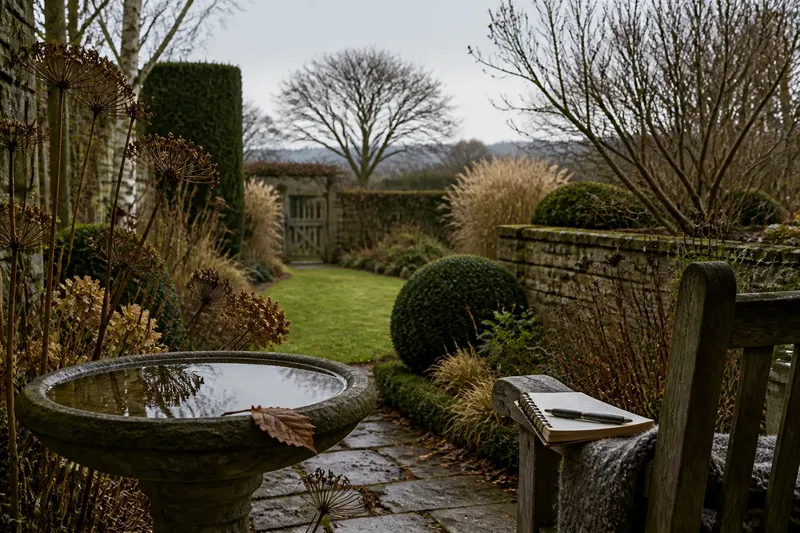
A damp leaf clings to the rim of a stone birdbath while the border behind it has gone mostly quiet. On a late-autumn garden visit, that contrast can draw your eye to the garden’s outlines: a low wall, a bare shrub, the dark ribs of a seed head. Set aside the urge to name every plant. Notice instead how the space holds together when flowers and foliage are no longer doing most of the visual work.
Choose a day when you can look without rushing, and bring a notebook or your phone for brief notes. You do not need to identify every species. Record what stands out, where it sits, and what appears to support it.
Set a viewing route
Begin at an entrance or a place where the whole garden opens up. Stand still before walking in. Look from the nearest edge to the farthest boundary, then notice what catches your eye first. It might be a clipped hedge, an evergreen mound, a tree trunk, or a pale patch of ornamental grass left standing.
Follow a familiar route, pausing near a border, beside a seating area, and somewhere with a view across several beds. These stops help you compare a form up close with the same form against its surroundings. A shrub that looks shapely from the path may merge into a dark fence from across the lawn.
At each stop, jot down a few plain observations. Try “rounded mass in front of the wall” or “thin stems interrupt the view of the gate.” Avoid deciding immediately that something should be pruned or moved. The first task is to see what is there, not to prescribe a change.
Read the outlines
With leaves fallen or reduced, the edges of plants become easier to follow. Look for each plant’s outer contour, then its internal lines: branching angles, upright stems, arching tips, or a dense network of twigs. An outline can feel soft, spiky, narrow, spreading, or almost architectural. Those impressions shape how neighboring forms appear.
Compare living outlines with fixed ones. A tree’s branching silhouette may echo a gate’s verticals, while a low mound may soften the straight edge of a raised bed. Notice where these forms meet. An abrupt change can make a corner feel crisp; a repeated curve can guide the eye without calling attention to itself.
Look at seed heads and dried stems as outlines, too. Fine lines can show against a wall or the sky, while a dense clump can read as one solid shape. Note whether these forms are visible from places where people actually stand, such as a bench, doorway, or kitchen window.
Compare open spaces
Next, pay attention to the spaces between plants. Late autumn makes gaps easier to see: the opening beneath a tree, the strip between a shrub and a path, or the view through a border to a fence. A gap is not automatically a problem. It can provide visual rest, reveal a pleasing background, or make the next cluster feel more substantial.
Ask whether each opening looks intentional from more than one viewpoint. A narrow space may seem balanced from the entrance but awkward from a seat. An apparent hole from one angle might align with a distant tree or garden feature when seen from the side.
Say you find a bare patch between a rounded evergreen and a deciduous shrub, with the fence visible behind it. From the path, the opening looks like a gap; from the bench, a small tree beyond the fence sits neatly within it. You write down both views and hold off on adding a plant, since filling the space could block the framed view from the bench.
Notice lasting forms
Look for features that keep giving the garden shape when seasonal color recedes. These might include a trunk, a clipped hedge, a large stone, a low wall, a trellis, or a substantial evergreen. Consider how each feature relates to its setting. Does it anchor an open area, divide one view from another, or give a border a clear end?
Check the balance of solid and delicate forms. A broad evergreen can steady a grouping of fine stems; several heavy shapes close together may make a corner feel crowded. Several airy plants against a plain fence may leave the space looking thin. You are not counting plants. You are comparing their visual weight and the room around them.
Notice texture as well as shape. Smooth bark, twiggy branches, dry seed heads, and rough stone catch light differently. Low winter sun can make ridges and branch patterns more apparent, while a gray sky may flatten them. If the light shifts during your visit, look again from the same place before deciding that a form disappears.
What should you record?
Should you identify every plant?
No. Record the plant’s location and visible shape if its name is uncertain. A note such as “arching shrub beside the gate” will still help you compare the space later.
Is bare soil a design problem?
Not by itself. Note whether the exposed ground reads as a deliberate pause, a seasonal opening, or a distracting break in the border from the views you use most.
When is a plant’s outline easiest to see?
Look when fallen leaves no longer cover nearby shapes, but do not rely on one visit’s light or weather. A return on a different day can reveal branch lines or spacing that were hard to read before.
What belongs in a useful note?
Write down the viewpoint, the form you noticed, and its relationship to nearby features. Add a quick sketch or a photo from the same spot if it will help you recognize the view again.
Turn observations into decisions
After the walk, group your notes by outlines, gaps, anchors, and textures. Mark observations that recur from more than one viewpoint. Those are often the clearest clues to the garden’s lasting structure. Keep single-view impressions, too, but treat them as questions to revisit rather than instructions to act.
Use the notes to identify one small decision, not to redraw the whole garden. You might decide to leave a standing seed head because its shape is visible from a window, or reconsider a crowded corner after seeing how several outlines overlap. If a plant needs care, base that work on its identity and relevant care guidance rather than appearance alone.
A late-autumn garden visit focused on structure is most useful when it leaves you with a clearer picture of the space, not a long list of corrections. Keep the route and a few notes for another seasonal visit. The same bench, gate, or window can show whether the garden’s outlines still make sense once new growth changes the view.