The Knot Garden and Its Patterned Past
A knot garden turns clipped plants into interlaced bands. See how to read its historical form and keep crossings clear as the planting changes.
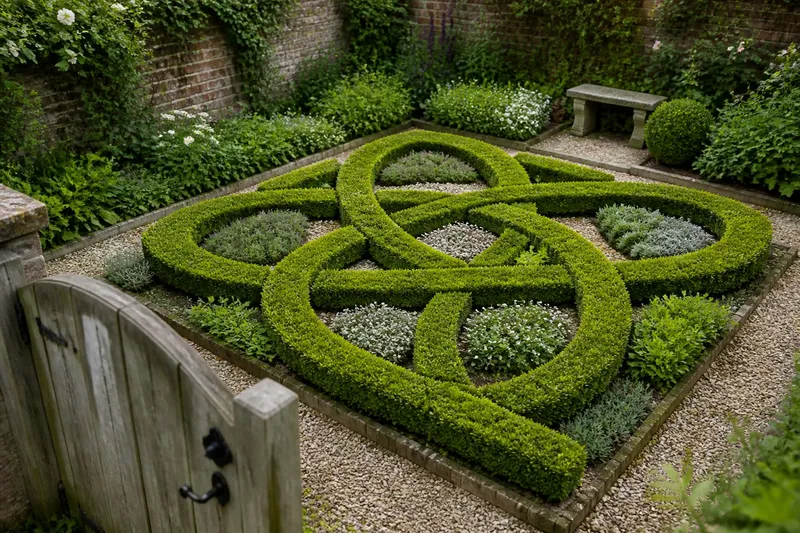
From a doorway, a knot garden’s clipped bands can seem to pass over and under one another. A knot garden is easiest to read from a place where the whole bed is visible, such as a gate or garden seat. Its patterned past is best understood as a visual idea, not as one fixed planting recipe.
Unlike a loose border, where plants can overlap and drift, a knot garden depends on continuous lines. The plants make those lines, and their edges help the design remain legible. If a band disappears or a crossing blurs, the whole arrangement can be harder to follow.
Knot garden history
“Knot garden” describes the impression of interlacing: linked bands seem to weave through one another. The layout may be symmetrical, but symmetry alone does not make a knot. The defining feature is a route the eye can trace through the crossings.
In historical garden design, knot gardens belonged to the formal vocabulary of enclosed, carefully maintained spaces. Their layouts and plantings were not identical everywhere or in every period. Low hedges and herbs are among the plants associated with these patterns, but the particular choices depended on the place and the design. It is safer to describe a shared visual principle than to imagine one universal traditional planting.
That principle is continuity. A naturalistic border can use varied heights and soft transitions; a knot needs its bands to remain distinct. A gap or blurred crossing can interrupt the pattern even when the plants are healthy.
Crossings that blur
A crossing may look clear on a drawing but merge when seen from ground level. Similar colors, crowded bands, or an awkward viewing angle can make the interlacing hard to follow. Before changing plants, look at the bed from the place where visitors usually see it.
If the lines blend together, simplify what surrounds them. Keep the clipped bands consistent in height, and consider a contrasting infill such as gravel, brick chips, or a low groundcover where appropriate. The aim is to separate line from background, not to add more ornament.
Say you have a small square bed whose crossing disappears from the garden gate. You place a garden hose along the existing hedge edges, then stand at the gate and note which curves merge. If the curves are clear from another spot, the viewing angle is the issue; if they still merge, you can decide whether to widen the visual gap or alter the infill in that section. You leave the rest of the pattern alone.
Edges that wander
Clipped plants grow unevenly, and trimming by eye can leave a curve lumpy or a corner blunt. In a loose border, such variation may feel natural. In a knot, it can make a band appear to swell or slip out of place.
Use the pattern as a guide. A taut string helps mark a straight section; a flexible hose can outline a broad curve before planting or reshaping. For an established bed, small stakes and garden twine can mark the intended route. Step back to check the line, since close-up trimming can make small deviations difficult to see.
Choose plants whose growth suits both the pattern and the attention you can give it. Fine-leaved herbs can create delicate lines; compact, small-leaved shrubs can make a more substantial outline. A plant that sprawls may need more frequent clipping to keep a narrow band readable.
Details that compete
Bright flowers, tall specimens, elaborate edging, and several kinds of infill can compete with the main lines. When the eye settles on separate objects instead of following the bands, the interlacing loses emphasis.
Let the clipped bands carry the design, then choose restrained infill that does not interrupt them. A central feature can work if it stays low enough to leave crossings visible from the usual viewing point. Color and texture belong in a knot garden, but they should not obscure its visual route.
This is one important difference from a loose planting. A mixed bed can make room for a spontaneous combination; a knot depends on deliberate boundaries. When a plant escapes its band, it changes how the pattern reads.
Seasonal changes
A knot garden may look fuller in one season than another. Flowering infill can fade, and herbs may become less dense. That change does not automatically mean the design has failed. The useful question is whether the outline remains legible when seasonal color recedes.
Consider the bed outside its most conspicuous season. Compact edging can preserve the pattern, while seasonal plants bring variety to the interior. If the crossings are visible only when a brief flush of growth fills the gaps, the underlying bands may need clearer definition.
For a small garden, a simple layout is often easier to maintain than a tightly interwoven one. Fewer crossings leave fewer places for growth to obscure the route. A modest pattern can still feel intricate up close if its bands stay continuous and the spaces between them remain distinct.
Questions about knot gardens?
What plants suit a knot garden?
Choose plants that stay compact, tolerate clipping, and suit the site’s light and soil. Low herbs or small-leaved shrubs can define bands, while gravel or a low groundcover can serve as infill.
Does a knot garden need symmetry?
No. Symmetry is common in formal patterns, but the essential feature is the interlaced route, not a mirrored layout.
How does a knot garden differ from a parterre?
The terms can overlap in garden history and use. A knot is especially recognizable by bands that appear to weave over and under one another; a parterre is a broader kind of formal bed and need not use an interlaced pattern.
Can a small yard hold a knot garden?
Yes, if the pattern suits the available view and the care you can provide. A compact layout with clear crossings is easier to read than a crowded pattern squeezed into the same space.
Reading the pattern
When a knot garden seems difficult to read, check what the eye can follow from the spot where people actually see it. Look for blurred crossings, wandering edges, competing details, or seasonal gaps. Each points to a different cause, so a focused change—clarifying the background, restoring a line, reducing visual competition, or simplifying the layout—may be enough.
The patterned past of the knot garden offers a useful design lesson: continuity matters more than abundance. A few clear bands can give a small bed a deliberate character, while extra decoration cannot rescue a route the eye cannot trace. Keep the crossings visible, and the pattern will remain recognizable as the planting changes.